
Written by: Tanis Zamora | Category: The Foundation

You’ve visualized the version of your life you want. You’ve said the affirmations every morning. You’ve kept a gratitude list going for months.
And somewhere in the middle of all of it, a quieter voice keeps saying none of this feels true yet.
That gap between doing the work and believing it isn’t a personal failure. Traditional Manifesting has no way to read that signal..
This article looks at why that gap exists — and what actually closes it.
Traditional Manifesting works well once belief is already in place. Visualization, affirmations, and gratitude sharpen belief that already exists — they were never built to create belief from nothing. That gap shows up in three different ways.
Traditional Manifesting treats belief as a starting requirement, not something built through evidence. Somebody who’s never built up six months of savings is asked to imagine it already sitting in the account. Somebody who’s argued with a partner every week for a year is asked to say their marriage is thriving. The instruction assumes the mind will simply accept the statement. For a person without supporting proof yet, that’s not a mindset problem. It’s a missing foundation.
Visualization doesn’t ask what’s making the picture hard to hold onto. Affirmations don’t ask why the words feel hollow the moment you stop saying them. Traditional Manifesting has no step to identify the habit, wound, fear, or limiting belief sitting underneath the resistance. When somebody skips their morning visualization because they’re anxious about a bill, the anxiety is the real problem. Nothing in Traditional Manifesting is built to address it.
When belief hasn’t caught up yet, acting as if starts to feel like acting. Saying “I am confident” while your hands are shaking doesn’t produce confidence. It produces a performance of confidence. This isn’t the technique done wrong — somebody following every instruction correctly can still feel like they’re reciting lines instead of living a truth. The gap isn’t in the execution. It’s in what the person honestly believes while executing it.
If a technique feels forced, it isn’t revealing failure. It’s revealing a barrier.

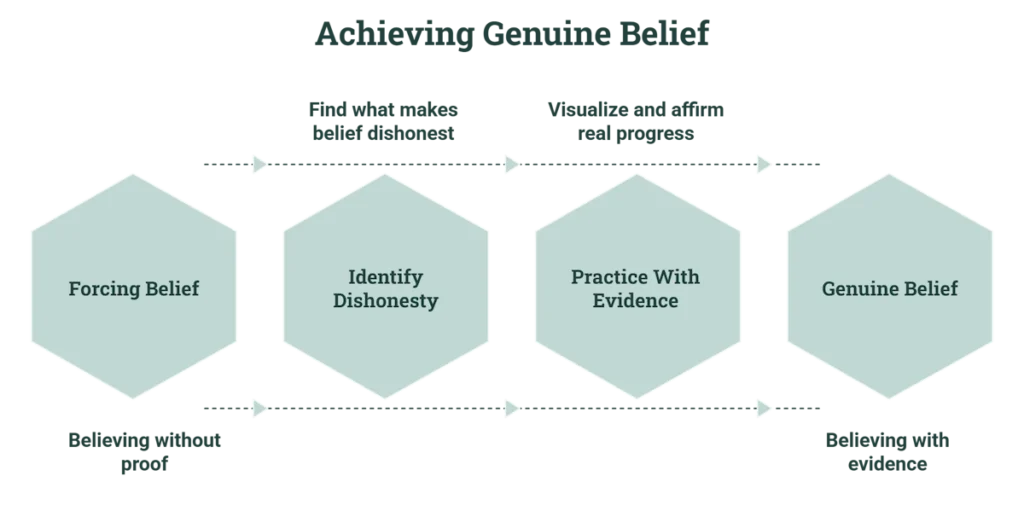
Backwards Manifesting works alongside Traditional Manifesting rather than replacing it. It fills in the step Traditional Manifesting leaves out: preparing the person before asking them to believe.
The question changes. Instead of “What should I visualize tonight?” it becomes “What’s making this hard to believe?” That shift moves the work from imagination to observation. A person avoiding their bank balance for months isn’t missing a better affirmation. They’re avoiding a barrier they haven’t named yet, and finding your barriers honestly is what makes the next step possible.
Small Wins give a person something to point to besides hope. Delaying a habit five extra minutes, keeping one promise to yourself, saving twenty dollars instead of zero — each one becomes proof instead of wishful thinking. Research on small wins backs this up.
Harvard Business School researchers analyzing thousands of workday diaries found that nothing contributed more to a positive, confident mindset than making progress, however small, on meaningful work. The pretending feeling fades for the same reason. Belief stops being something you force and starts being something you notice, because Real Evidence is finally sitting behind it.
As barriers shrink, the same visualization session starts to land differently. Affirmations stop sounding like a script and start sounding like a description. Nothing about the technique changed. The person reciting it did.
Traditional Manifesting isn’t broken. It assumes belief is already available, and for many people, it simply isn’t yet. The fix was never a better technique. It was removing whatever stood between the person and the belief the technique required. Once that barrier is smaller, visualization, affirmations, and gratitude go back to doing exactly what they were built to do — and if this is still where you are, why you can’t believe your manifestations may be the next place to look.
That feeling usually means a personal barrier — a habit, fear, or limiting belief — is standing between you and honest belief, not that you’re doing the technique wrong.
No. Backwards Manifesting works alongside Traditional Manifesting, helping you remove the barriers that make techniques like visualization and gratitude feel forced.
If a technique consistently feels dishonest or impossible to believe despite consistent practice, it’s usually a sign that a barrier needs to be identified and addressed first.
Explore more Backwards Manifesting articles and continue preparing for the life you’re manifesting.
Surround yourself with people who are preparing for the life they’re asking for. Share your progress, learn from others, ask questions, and grow together.
We’re creating the Beyond The Prayer Community—a place to connect, share what you’re learning, ask questions, and encourage one another along the way.
We’re not quite ready to open the doors, but you can be among the first to know when we do.